For four years, Abiodun Adetona was the engineer at Flutterwave that non-technical colleagues went to when they needed data pulled from a spreadsheet. The same colleagues. The same questions. Almost every day, for nearly a year. He left in 2025, hired two engineers, and built the tool he had been impersonating.
Decide AI launched without funding, without marketing, and without a Silicon Valley address. 1,000 users in the first 24 days. 3,000 by February. And one number that mattered more than either of those: 82.5 percent on SpreadsheetBench Verified, an independently evaluated 330 out of 400 tasks, posted on the public leaderboard in January 2026.
The problem
Spreadsheets run a quiet share of the world’s actual work. Finance teams build models in them. Operations teams run dashboards from them. Researchers analyze data in them. And in most companies, doing any of this well requires either a developer or hours of manual cleanup. The non-technical user who has the question rarely has the skills to extract the answer.
The result is a tax most companies have stopped noticing. KPMG analysts spend evenings cleaning data instead of interpreting it. Operations managers wait three days for engineering to generate a report they need today. Researchers run regressions in scripts they cannot debug. The cost is not a single line item; it’s the slow drag of professional time being routed to data plumbing.
The solution
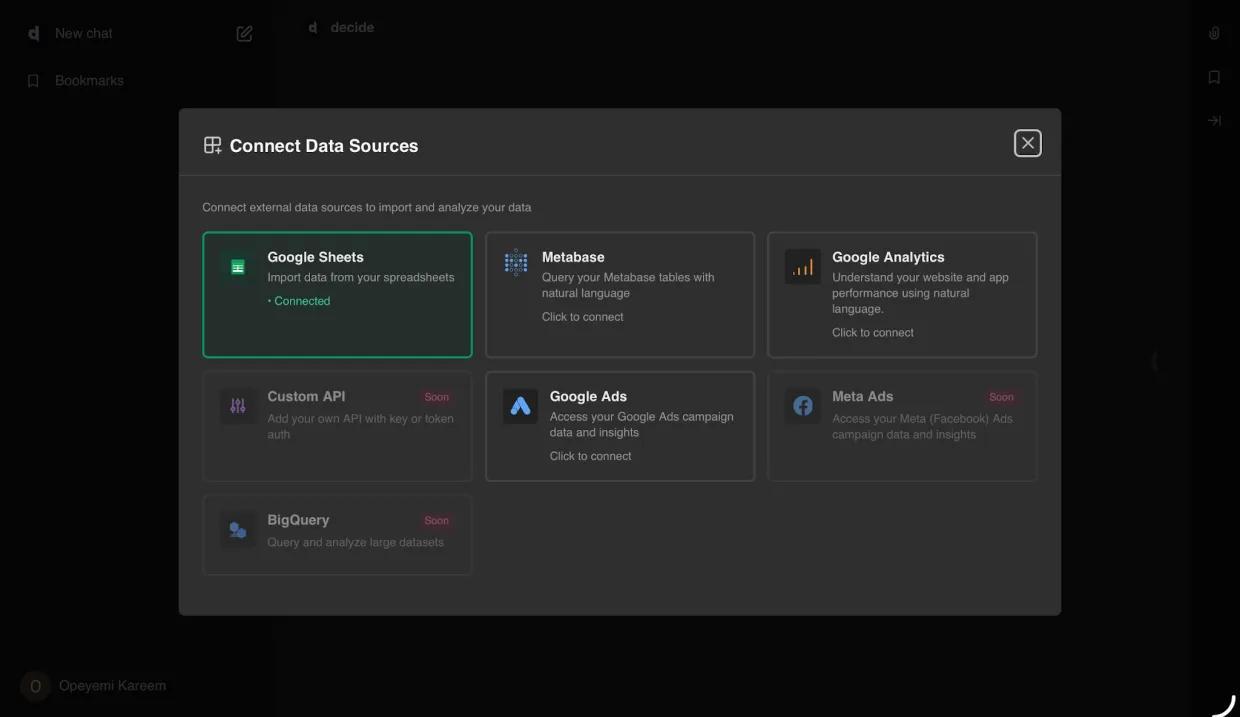
Decide is an AI agent for Excel and data analytics. Upload a spreadsheet or connect a data source, describe what you want in plain English, and the agent executes real code to produce the result. Clean a column. Build a dashboard. Run a regression. Merge ten messy files into one. The output is verifiable, the underlying code is inspectable, and the spreadsheet’s original structure is preserved.
The pricing is consumer-friendly: $7 a month for the entry tier, $15 for the heavy-use tier. Professionals at KPMG, Bank of America, OPay, Renmoney, and PwC are listed on the homepage as users. 21,000 spreadsheets have been created on the platform; 41,000 analysis runs have been completed.
The bet
The interesting story is not the score itself.
SpreadsheetBench was built by researchers at Renmin University and Tsinghua and accepted as a spotlight at NeurIPS 2024. It has two leaderboards: a full 912-task version where models can be evaluated by external third parties, and a 400-task Verified subset where teams submit through a standardized API for independent testing. Microsoft, OpenAI, and Anthropic appear on the full leaderboard with Unverified status, scoring 57.2 percent, 45.5 percent, and 42.9 percent respectively on their respective evaluations. On the Verified subset, they do not appear. Decide submitted, and scored 82.5 percent.
Other small teams have since followed and posted higher numbers on the same Verified leaderboard, and the rankings will keep shifting. The interesting move is the choice to submit at all. A 3-person team in Lagos with no external funding decided the credibility of independent evaluation through a standardized API was worth the risk of public failure. Several of the largest AI labs in the world, with hundreds of billions of dollars in resources, have made a different choice on this benchmark.
That is a different kind of bet than a leaderboard ranking. It is a bet about how small teams should compete in AI: not by claiming higher scores than larger labs, but by willingly testing themselves in places larger labs have avoided.
What to watch
The category is about to get crowded. Microsoft will eventually bundle agentic AI into Excel itself, and that version will be free. OpenAI’s ChatGPT and Anthropic’s Claude both have data analysis features that will improve. Decide’s wedge is the discipline of independent evaluation, but discipline only stays valuable if the team keeps re-submitting as the benchmark evolves and new versions emerge.
2 things will tell us whether the bet holds. Whether Decide keeps submitting and improving its score on successive evaluations, since the willingness to test publicly is the position, not last quarter’s number. And whether the team can translate user growth into sustainable paid conversion at the current pricing, since AI inference costs on power users can erase the margin on a $15 plan quickly.
What we’re rooting for
Spotlight is rooting for Decide to add 500 new paying customers by end of Q3 2026. That’s a meaningful business signal for a 3-person team with no external capital, the kind of number that converts a public evaluation track record into a sustainable company. We’re cheering every conversion, and we hope Abiodun comes back to share the win when the cohort lands.
Knowledge workers and analysts can try Decide.