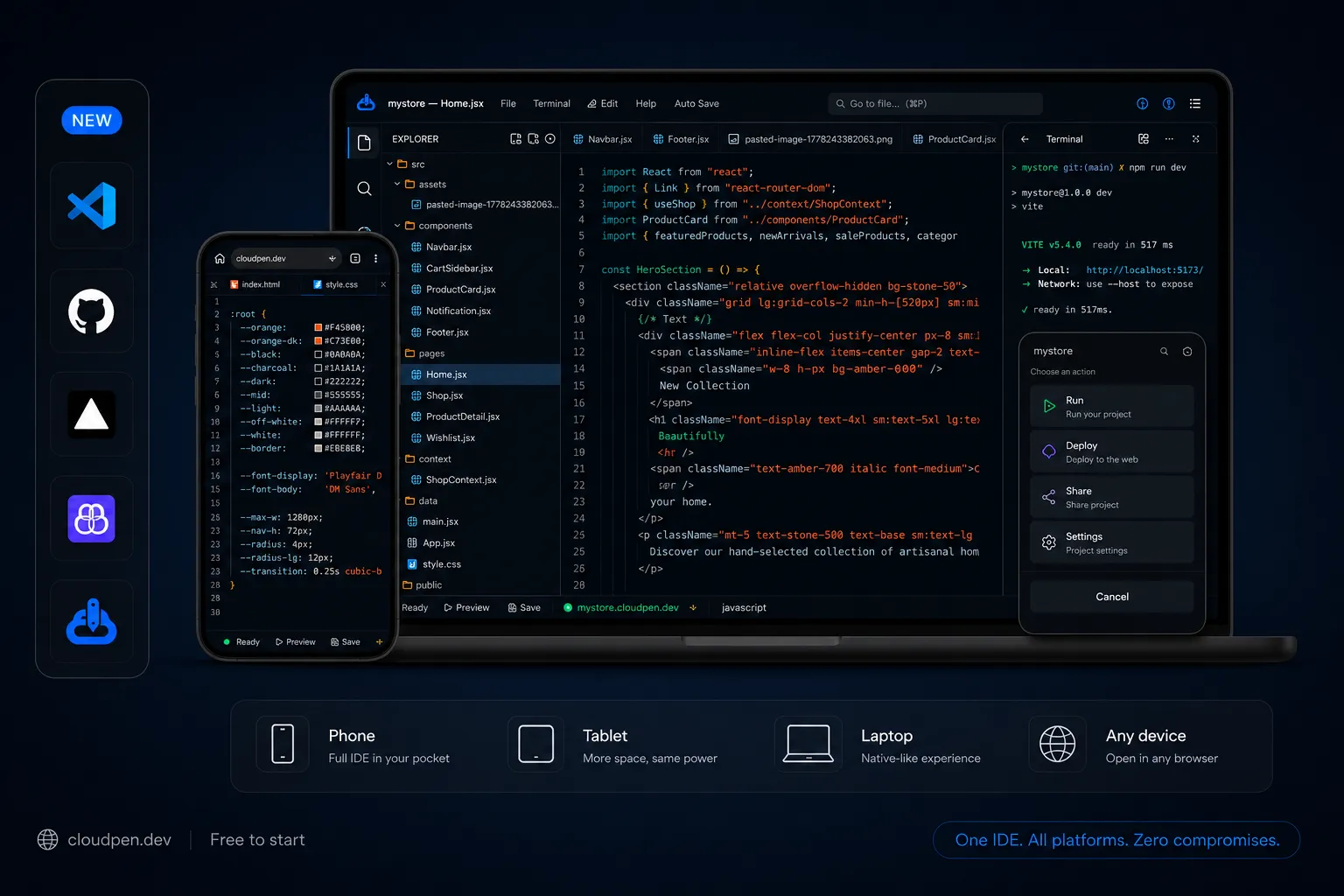
Augustine Chibueze opened his laptop, pulled up his phone, and shipped a code editor to both. Same editor. Same terminal. Same file tree. Same one-click deploy button. On the phone, everything works. Not a stripped-down mobile view of a desktop tool. The real editor, running inside a browser tab on a device that fits in a pocket.
He spent several months building it alone. The first public post went up on dev.to on May 29, 2026. A Product Hunt launch followed on June 10. The product, Cloudpen, is live at cloudpen.dev, listed on LaunchPad NG (Nigeria’s directory for indie makers), and priced at $12 a month on a launch discount from $24.
The problem
The modern developer toolchain has quietly become a fragmented mess. Even a simple project routinely involves four separate tools with four separate logins: an editor like VS Code, source control on GitHub, deployment on a platform like Vercel, and an AI assistant like Copilot. The free tiers are generous. That’s not the issue. The issue is that setting up a working project means installing an editor, creating accounts, connecting them together, configuring deployment, and reading docs on how each one works. For a developer with a laptop, a stable connection, and hours to spend, this is manageable.
For a self-taught developer coding on a phone, or a student on a borrowed machine, or a working programmer trying to ship a side project between shifts, the four-tool onboarding is where they quietly drop off. Not because they can’t afford it. Because they can’t finish the setup on the device they actually have.
The solution
Cloudpen puts the whole stack in one browser tab. The code editor is Monaco, the same engine that powers VS Code. The terminal is a real PTY over WebSocket, not a simulated shell. GitHub sync uses OAuth and webhooks, so a push to a repository triggers an automatic redeploy. A one-click deploy button ships a project to a live URL with an SSL certificate. Custom domains attach via a single CNAME record. A built-in AI assistant called Quill sits inside the editor, with a BYOK option for developers who want to use their own model keys.
Real-time team collaboration is included, with role-based permissions (Owner, Admin, Write, Read-only). An offline mode lets developers keep working when the connection drops and syncs on reconnect. Pricing: Free tier with no credit card, $12 a month for Pro (currently a launch discount from $24), $29 a month for a three-seat Team plan. Students and bootcamps get 50 percent off.
The bet
The mobile-first design is the story.
Most cloud IDEs treat mobile as an afterthought. Their web apps technically load on a phone, but the editor buttons overlap, the terminal is unreadable, and the deploy flow assumes a mouse. Augustine built Cloudpen the other way around: the file tree, search, editor, terminal, and deploy button all work on a phone the same way they work on a laptop. That is not a marketing claim about the interface; it is a claim about which device set the constraint during development.
The bet underneath is who the future developer looks like. In much of the world, a phone is the primary computer. A student in Enugu writes code on a $150 Android. A junior developer in Karachi ships features between shifts on the phone in his pocket. The dominant developer-tool category assumes those users will upgrade to a laptop eventually. What Cloudpen assumes is that they will not, or that the wait is long enough that the tools should meet them where they are. If that read is right, the mobile-first constraint is not a nice-to-have. It is the whole product.
What to watch
Two things will tell us whether the bet holds.
Whether the setup convenience holds as the incumbents react. GitHub Codespaces and Replit are already browser-native; if they invest harder in mobile and streamline their onboarding, Cloudpen’s wedge narrows. And whether the paid-conversion numbers actually materialize, since indie tools with generous free tiers often struggle to move users off them. A cloud IDE also carries real infrastructure costs per active user, which means Cloudpen’s unit economics depend on paid conversions rather than free-tier growth being an unqualified win.
What we’re rooting for
Spotlight is rooting for Cloudpen to add 50 new paying developers by end of Q3 2026. That is a stretch but real target for a solo builder 5 weeks into a public launch. At $12 a month, 50 conversions is the kind of early business signal that turns a bootstrapped side project into a company with a path. We’re cheering every signup, and we hope Augustine comes back to share the win when the cohort lands.
Developers can try Cloudpen.